
Story of Panch Kedar: The Untold Truth About Shiva’s 5 Sacred Temples Hidden in the Himalayas

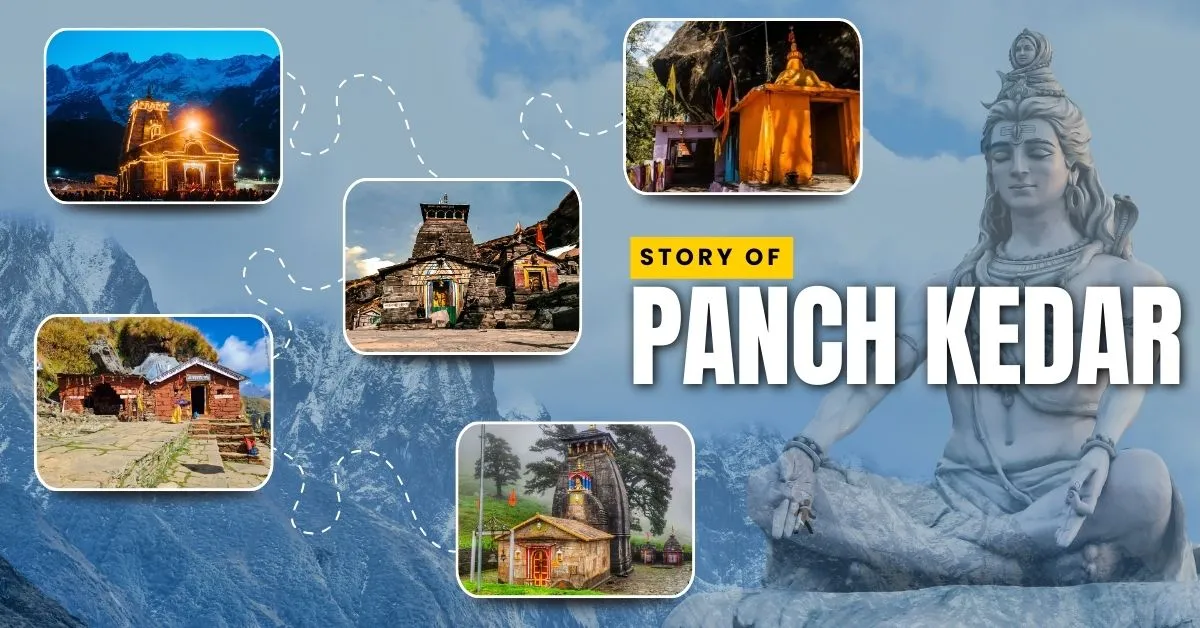
Uttarakhand famous for the title “Land of Gods”, as you will see number of gods temple here. All temples tells the story from ancient times. These temples hold great importance in Hindu tradition. Among all the temples in Uttarakhand, there was the temple known as Panch Kedar. There is a story of panch kedar related to all the temples. Panch Kedar as the name suggest, is the five different forms of Shiva worshipped in five different temples. These temples are – Kedarnath, Tungnath, Rudranath, Madhmaheswar and Kalpeshwar. These are the five sacred temples dedicated to Lord Shiva situated at the Himalayan range of Uttarakhand. The story of Panch Kedar temple is gentle, emotional and full of devotion. Each temples has its own unique story and spiritual energy. To know the mythological importance visitors come here and learn about the story of Panch Kedar.
For centuries, people have travelled across rocky paths, snow-covered trails, and quiet forests to reach these holy places. These journeys—known as the Panch Kedar Yatra—are believed to bring peace, blessings, and enlightenment. Even though the journey is long and sometimes difficult, thousands of people of all ages complete it every year. The Panch Kedar temples are not only important for religious reasons. They also play a big role in showcasing the rich cultural history of India. These temples are connected to the epic Mahabharata, the Pandavas, and their journey to seek forgiveness from Lord Shiva. The entire story of Panch Kedar beautifully links devotion, history, and the Himalayas.
Story of Panch Kedar
There are several mythological story behind the existence of Panch Kedar temples. One of the story of panch kedar, according to the mythological legend is connected to the Mahabharata. It explains why the five temples, Kedarnath, Tungnath, Rudranath, Madhyamaheshwar, and Kalpeshwar, came into existence.
This story begins after the great Kurukshetra war, a conflict that left thousands dead and the Pandavas burdened with guilt. They wanted to wash their sins. So on the advice of Krishna, they left in search of Shiva and to seek forgiveness directly from Lord Shiva. First, they went to the holy city of Varanasi (Kashi), as it is believed to be Shiva’s favourite city and known for its Shiva temple. But lord shiva avoid them as he was upset with the violence held in the war. So he disguised himself as a bull and roamed through high mountains. Not finding Shiva in Varanasi, the Pandavas went to Garhwal Himalayas. There he saw a bull grazing near Guptakashi. Pandav second brother Bhima recognized the bull to be Shiva. But shiva tried to disappeared into the ground but Bhima held onto the bull’s body with all his strength, and in this struggle, Shiva’s body split into five different parts. Each part emerged at a different place across the Himalayas, and these places later became the five sacred Panch Kedar temples. The hump of the bull appeared at Kedarnath, the arms of bull appeared at Tungnath, the face of bull appeared at Rudranath, the middle part of the bull or navel appeared at madhyamaheshwar and the matted hair of the bull appeared at the kalpeshwar. This entire legend is the foundation of the story of Panch Kedar known today.
To show their devotion and to honor Lord Shiva Pandavas built temples of Shiva at each of the five places. It is believed that after worshipping at all five temples, the Pandavas were finally forgiven and the Pandavas were thus freed from their sins.
Also Read This : 10 Famous Temples of Uttarakhand You Should Visit
Kedarnath – The Hump of the Bull
Kedarnath is one of the most famous temple of the Panch Kedar. The story of panch kedar related to this place is that the hump of Lord Shiva’s bull form appeared here. It is located on the Garhwal Himalayan near the Mandakini river at an altitude of 3583 meters. As one of the twelve Jyotirlingas and one of the four major sites in India’s Chota Char Dham pilgrimage, it carries deep religious significance for Hindus.
Historically, Kedarnath Temple is believed to be thousands of years old, originally built by the Pandavas and later restored by Adi Shankaracharya. Adi Shankara was believed to have revived this temple, along with Badrinath and other temples of Uttarakhand; he is believed to have attained Mahasamadhi at Kedarnath. The presiding image of Kedarnath in the form of lingam is more triangular in shape with a pedestal
Kedarnath temple survival through extreme weather and natural calamities—including the devastating 2013 floods—is considered a miracle. Many believe divine protection keeps this sacred temple safe.Due to heavy snowfall, the temple remains open for only six months of the year (typically May to November). The Kedarnath trek is one of the most popular routes of the Panch Kedar Trek. It starts from Gaurikund, covering a distance of about 16–18 km that typically takes 6-8 hours to complete.
Tungnath – The Arms of the Bull
Tungnath is the second temple in the Panch Kedar circuit and the story of panch kedar related to this place is related to the arms of Lord Shiva’s bull form appeared. This temple is the highest Shiva temple in the world, located in the Rudraprayag district at an altitude of about 3,680 meters. The Tungnath mountains forms the Mandakini and Alaknanda river valleys.
The temple is made from stone in the traditional Himalayan style, with simple carvings. Local priests from nearby villages have been taking care of the temple for generations. Like other temples Tungnath temple remain closes for six months due to heavy snowfall. the temple is closed and the symbolic image of the deity and the temple priests are moved to Markandeshwar Temple in Makkumath village.
Of all the Panch Kedar trek routes, the route to Tungnath is the shortest: only 5 km from Chopta, which can be covered in approximately 4–5 hours.
Rudranath – The Face of the Bull
Rudranath is the third temple in the Panch Kedar group and is believed to be the sacred place where the face of Lord Shiva’s bull form appeared. The name “Rudranath”, literally means “He who is Angry.”
It is a Hindu temple located in the Chamoli district of Garhwal region which is located at an altitude of 2290 meters above sea level, According to the legend, after Lord Shiva divided his bull form, his face emerged at Rudranath. Devotees believe that his face represents truth, purity, and inner reflection. Priests from nearby villages live in the area during the summer months to perform rituals and prayers. In winter, a symbolic image of Shiva is brought from Rudranath to Gopinath Mandir in Gopeshwar for worship.The Rudranath trek is considered the toughest of the Panch Kedar trek routes. This temple is a major part of the story of Panch Kedar because it represents Shiva’s divine expression.
Madhyamaheshwar – The Navel of the Bull
Madhyamaheshwar, also known as Madmaheshwar, is the fourth temple in the Panch Kedar group and there is beautiful story of Panch Kedar related to this temple. It is believed that the navel (middle part) of Lord Shiva’s bull form is appeared here. This temple is located in Rudprayag district of Uttarakhand. It is located at an altitude of around 3,289 meters, this beautiful temple sits in a quiet mountain valley surrounded by lush meadows, flowing streams, and towering snow peaks like Kedarnath and Chaukhamba.
It is believed that the water from the temple is considered so sacred that even a few drops are stated to be adequate for ablution. Devotees believe that praying here helps in emotional healing, inner peace, and balancing one’s thoughts. The temple is closed during winter due to heavy snowfall here. During the winter period the symbolic idol of the god is shifted with full rituals to Ukhimath for continued worship.
The best time to visit the temple is from April to September. The Madhyamaheshwar trek is considered one of the most beautiful and moderate-level trails in the Panch Kedar Trek. The journey usually begins from Ransi Village, which is the last motorable point. From Ransi, the trek covers about 16–18 km, passing through gorgeous forests, small Himalayan villages, river bridges, and rolling meadows.
Kalpeshwar – The Hair of the Bull
Kalpeshwar is the fifth temple in the Panch Kedar circuit, and it holds a unique story of panch kedar that sets it apart from the others. It is believed to be the sacred place where the matted hair (jata) of Lord Shiva’s bull form emerged from the earth. It is a hindu temple located in Urgam valley located at an elevation of 2200 meter. As all other panch kedar temples remained closed during winter, Kalpeshwar temple remain open throughout the year. This is the only temple from the panch kedar temple that is open for all the months of the year. So devotees can take blessings of Shiva without the seasonal barrier. The Kalpeshwar trek is the easiest among all routes of the Panch Kedar Trek, making it a perfect choice for beginners or those who prefer easy walks over challenging climbs. The temple plays an essential part in the story of Panch Kedar as it marks the final resting place of Shiva’s divine form.
Other Nearby Places to Explore Around the Panch Kedar Temples
After knowing the story of panch kedar lets explore the nearby places that you can visit here. There are many places to visit near these Panch Kedar Temples. Some of the best places to visit near Panch kedar temples were :
- Vasuki Tal (Near Kedarnath) – Vasuki Tal is a beautiful high-altitude lake located above Kedarnath. It is located about 8 km from Kedarnath at an elevation of 4,135 meters. It is surrounded by snow-covered mountains and Himalayan flowers and also it gives a beautiful view of Chaukhamba peaks. The trek to this lake is challenging, but the experience is outstanding, making it perfect for nature lovers and adventure seekers.
- Bhairavnath Temple (Near Kedarnath) – This temple is dedicated to Bhairavnath, who is known as the Kshetrapal of Kedarnath. It is believed that Bhairavnath protects the valley, especially during winter when Kedarnath remains closed. It is believed that before the main Kedarnath Temple opens its doors, prayers are offered here.
- Chandrashila Peak (Near Tungnath) – Just above Tungnath lies Chandrashila Peak, a famous trekking spot. The trek to the peak is 5 km. The sunrise from this point is considered one of the best in Uttarakhand. On clear days, trekkers can see major Himalayan peaks like Nanda Devi, Chaukhamba, Bandarpunch and Kedar peaks.
- Triyuginarayan Temple (Near Kedarnath) – The Triyuginarayan Temple is an ancient and historic temple located near Kedarnath. It is the place where the marriage of Lord Shiva and Goddess Parvati happens. A continuous flame known as the Akhand Dhuni is said to have existed in this location since their wedding. The Temple’s architecture is very similar to Kedarnath and is situated amongst beautiful mountain ranges and forest areas. This temple is a popular pilgrimage destination for many couples who wish to receive blessings for their marriages. The Temple is approximately 12 kilometers from Sonprayag and can be reached via road or a short trek.
- Buda Madhyamaheshwar (Above Madhyamaheshwar Temple) – It’s an ancient Shiv temple located above the madhyamaheshwar temple. A short but steep trek from Madhyamaheshwar takes visitors to Buda Madhyamaheshwar. When the main Madmaheshwar temple is closed due to snow, the idol is moved to Buda Madmaheshwar, and worship continues there.
Conclusion
The story of Panch Kedar is much more than collection of ancient myths and stories. Its a beautiful part of India’s history, culture and spiritual beliefs. Each of these five temples tells a story about Lord Shiva and the Pandavas. Traveling to Panch Kedar temples is not just a religious trip it gives people a chance to explore the real beauty of the Himalayas its forests, rivers, fresh air, and huge snow-covered peaks.The history and legends behind these temples also remind us that everyone can learn from their mistakes, just like the Pandavas did. Whether someone visits Panch Kedar for prayer, adventure, trekking, photography, or simply to relax in nature, the experience always stays in their heart. Every temple of Panch Kedar tells the story of Panch kedar that makes the people’s yatra unforgettable
